
From Oct 2024 to May 2025
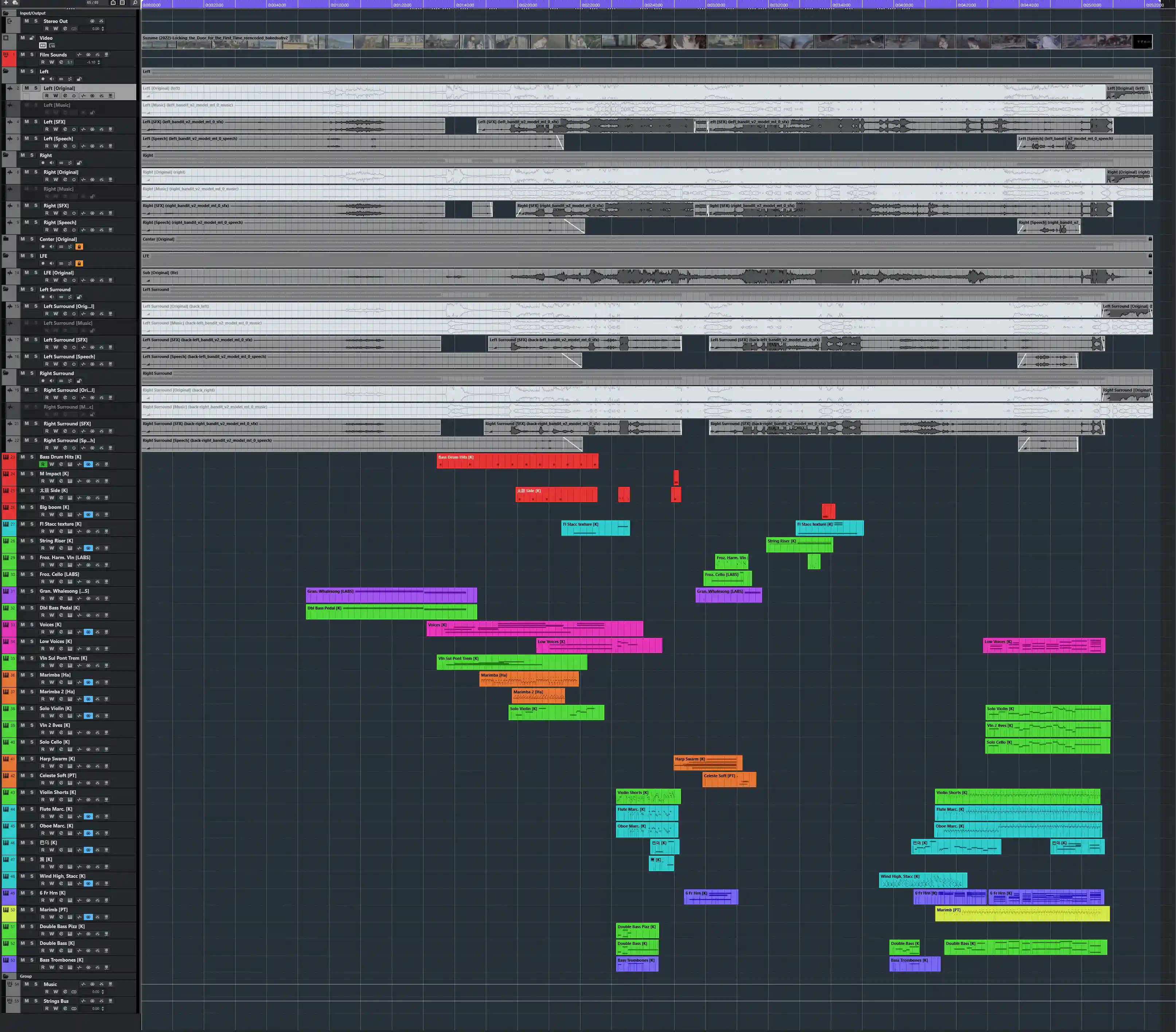
For my final year at the University of York, I took the module ‘Extended Composition Folio’. This involved planning, writing, and executing a portfolio of compositions alongside a commentary. It was a perfect opportunity to focus on scoring music to picture and to receive weekly one-to-one tutorials.
The project consists of two works: Re-scoring a 25-minute episode of the televised series, ‘Sousou no Frieren’
, and re-scoring a 5-minute scene from ‘Suzume no Tojimari’
.
(Click to the links above to see more information.)
Grade Awarded: 90
“This is an excellent submission. Not only have you provided the work to be assessed, but also a 5.1 version of Suzume, timecoded versions, the original films, project files and we get to hear you sing in Japanese. This is a very well thought through project.
It’s great to have the 5.1 mix of Suzume as the fantastic lower end of the pitches in this scene resonate in a much more powerful way. The two pedals at the start of the scene are timed really well and it’s good that you allowed the dialogue to play out without music as the music becomes part of the drama rather than part of the mundane every day. The solo violin adds an authentic touch as the active piano music conveys the pace of the cycling and then at 2.33 the arpeggiated piano music is transferred to a more complex web of instruments that provides excitement. There is good rhythmic interplay here and later on in the second part of the scene. The Ligeti/Penderecki swirling is a really interesting addition to the musical variety in the short scene. From 3.58 I am very strongly reminded of Reich’s Variations (not a criticism). The first conventional cadence at the hit point when the key hits the lock is very well timed (your THX moment).
The commentary gives us information about the conventions surrounding the musical approach for this series and you have appropriately provided us with opening and closing songs with different characters (and yes, the ending song does reflect the subdued nature of the episode) and several cues. As with the original version, you largely let dialogue remain unscored, but when you do create music under the dialogue for emotional reasons, your cues are not obtrusive. There is a sense that the moments between the music are culturally connected to ma. Throughout you have maintained a calm approach and your orchestration provides attractive combinations of instruments that often create a rich palette of colour. Cues such as at 5.05 with piano etching out 3rds etc. does not get in the way of the dialogue and even with the addition of the violin it remains in the background. The original version’s cue at this point is a bit busy and yours is preferable. Music that crosses various scenes is rare but when it happens (as it does later on from about 16.30) the transitions are handled well. I did wonder if the moment at around 13.00 needed a little dramatic underscore, but it would have been brief if so. Overall, the music here reflects the character of the episode and you have followed a tradition. The one musical aspect you haven’t gone near - and for me one that is odd - is that often in the music of this series (or at least what I have listened to) the music has a Gaelic quality.
The commentary is excellent with lots of technical detail and clear explanations about how you conceived the score. The one thing it could have done with was a synopsis as without looking it up, there are no subtitles to help guide us through.
Excellent work, congratulations!”